


Opposition parties and civic groups are working together on a full-scale protest that includes legislative boycotts, a “siege” of the legislature and street rallies after the Chinese Nationalist Party (KMT) cut short the review of the cross-strait service trade agreement on Monday and sent the pact directly to the plenary session for its second reading.
At about 9pm, more than 300 students and demonstrators broke from the rally outside the Legislative Yuan, broke into the compound and took over the podium on the legislative floor.
The police did not evacuate the protesters.
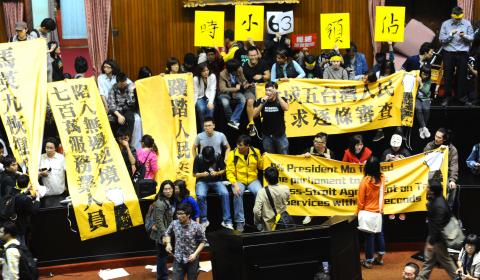
Photo: Chang Chia-ming, Taipei Times.
The protesters staged a sit-in in the assembly hall where lawmakers hold meetings, saying that they would stay there until Friday and until the KMT withdraw the agreement from the plenary.
The protesters called on supporters to bring supplies to the site.
The KMT caucus has breached a previously reached inter-party consensus that the pact — which experts said could severely affect local industries — must be reviewed clause-by-clause in the Legislative Yuan, which has infuriated the public, the opposition said, adding that the move amounted to contempt of parliament and a betrayal of democratic principles.
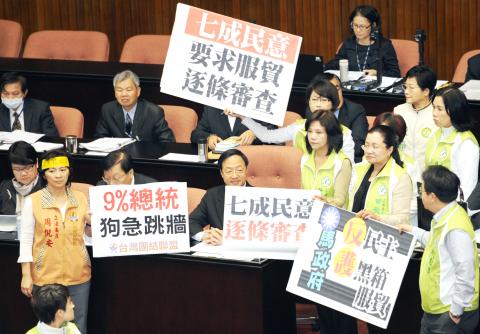
Photo: Lo Pei-der, Taipei Times
In response, the Democratic Progressive Party (DPP) and the Taiwan Solidarity Union (TSU) boycotted the Legislative Yuan’s plenary session yesterday, forcing Legislative Speaker Wang Jin-pyng (王金平) to announce an adjournment for party negotiations.
Opposition parties vowed to continue boycotting the plenary until the KMT retracts the agreement.
With President Ma Ying-jeou’s (馬英九) administration and the KMT showing no signs of retracting the agreement, DPP Chairman Su Tseng-chang (蘇貞昌) yesterday said the party would launch a series of “countermeasures” against the KMT over the next three days.
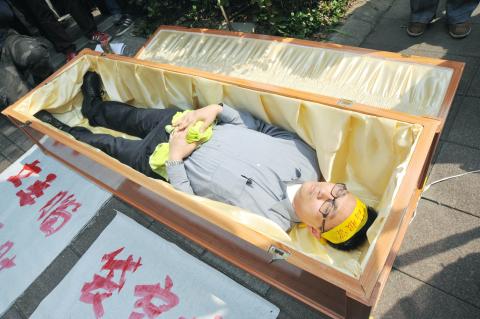
Photo: Mandy Cheng, AFP
The DPP said that it would propose a “better agreement” than the current service trade pact in its Central Standing Committee meeting today and convene a meeting with representatives from various industries and civic groups tomorrow to discuss the establishment of an alliance to monitor the review of the agreement.
In addition, the party plans to launch a campaign to “besiege” the Legislative Yuan.
“Our goal to review the pact clause-by-clause and to renegotiate the deal remains unchanged,” Su said.
The TSU is mobilizing its supporters and industry representatives to “besiege” the Legislative Yuan on Friday, with TSU Chairman Huang Kun-huei (黃昆輝) accusing the KMT of breaching the consensus, which Huang called unacceptable.
Speaking to reporters after the plenary session yesterday, Wang said that although the KMT’s handling of the review surprised him, he would not speculate on what the pan-blue and pan-green camps would do next week.
While another round of inter-party negotiation is needed, “the atmosphere is not appropriate for both camps to sit down and talk at this moment,” Wang said.
At separate press conferences, DPP caucus director-general Gao Jyh-peng (高志鵬) said that the party would continue boycotting plenary sessions until the KMT offers a concession, while DPP Deputy Secretary-General Lee Chun-yi (李俊毅) insisted that the agreement should stay in the committee and be reviewed line-by-line.
Former premier Frank Hsieh (謝長廷) of the DPP posted on Facebook that he supported an “all-out protest” in collaboration with the public against the KMT.
Dozens of civic group representatives and students, who have had been camping outside the Legislative Yuan since Monday, stepped up their mobilization efforts, urging the public to join the sit-in and an overnight rally to voice their opposition to what they called the KMT’s “brutal” decision that had completely ignored the interests of the Taiwanese.
DPP lawmakers Hsiao Bi-khim (蕭美琴), Wu Yi-chen (吳宜臻) and Wu Ping-jui (吳秉叡) also staged a 70-hour hunger strike, which began at noon yesterday and would last until 10am on Friday, when a plenary session is scheduled to commence.
The protest in front of the Legislative Yuan would continue until Friday, according to Lai Chung-chiang (賴中強), convener of the Democratic Front Against the Cross-strait Trade in Services Agreement and spokesperson of the rally.
Beginning yesterday morning, the police have reinforced deployment and have installed a road block around the Legislative Yuan compound to keep the protesters from entering the compound and to prepare for the planned siege on Friday.

The National Chungshan Institute of Science and Technology yesterday showcased its locally developed variants of the Vision 60 robotic patrol dog, which it plans to deploy on the nation’s outlying territories in the South China Sea. The variants were produced under the Joint Lab project — created by the institute and domestic companies — and assembled with domestically produced motors, lenses and artificial intelligence (AI) systems alongside licensed tech from the US, Missile and Rocket Systems Research Division deputy director Jen Kuo-kang (任國光) told the media event at a military base in Taipei’s Dazhi (大直) area. Taiwan has built up its strengths

RIGHT DIRECTION: Taiwan’s efforts to prevent forced labor include a proposal to ‘fully prohibit’ employers from withholding workers’ documents, an official said Taiwan is to establish a mechanism to restrict imports of goods linked to forced labor, the Executive Yuan said yesterday, after the US proposed imposing additional tariffs on Taiwanese goods over labor concerns. “The Ministry of Labor and the Ministry of Economic Affairs are to establish an interministerial review procedure,” Executive Yuan spokesperson Michelle Lee (李慧芝) said at a news briefing in Taipei. “The government is to use the Foreign Trade Act [貿易法] as the legal basis to restrict imports of goods produced with forced labor” and bring its supply chain governance more in line with international standards on human rights, resilience
NOT IMMEDIATE: Taiwan has a chance to appeal the proposed 10 percent tariff before it starts, while other countries face a 12.5 percent tariff from the trade office Taiwan is among 60 economies determined by the US to have failed to impose or enforce a ban on the importation of goods produced with forced labor, according to a notice released on Tuesday by the Office of the US Trade Representative (USTR), which proposed imposing an additional 10 percent or more tariff on them. The USTR in a statement said that following an investigation, it had determined under Section 301 of the Trade Act of 1974 that the failure of the 60 economies to impose and effectively enforce a prohibition on the importation of goods produced with forced labor is

TIT-FOR-TAT: The US allegedly revoked the visa of a Chinese national working at Xinhua News Agency in the US in response to Beijing’s expulsion of Vivian Wang The Presidential Office yesterday condemned China for expelling a New York Times correspondent from Beijing following the newspaper’s interview with President William Lai (賴清德), saying the move highlighted Beijing’s suppression of press freedom and its threat to international news media. Taiwan has noted a series of recent incidents in which Beijing used similar tactics to “threaten and pressure international media outlets and journalists,” Presidential Office spokeswoman Karen Kuo (郭雅慧) said in a statement. “This concerns not only press freedom and freedom of expression, but also the safety of journalists, and Taiwan and relevant partners are paying close attention to the situation,” she


 RSS
RSS